Why Everyone is Buying the Asus Rog Nuc 2025 (Full Review)
Introduction: I Didn’t Expect a “Mini PC” to Replace My Laptop Routine
I’ll admit it: when I first heard people raving about the Asus ROG NUC 2025, I rolled my eyes a little. I’ve owned gaming laptops, I’ve built compact desktops, and I’ve tried more than one “tiny powerhouse” PC that looked great on paper but fell apart in day-to-day use—loud fans, odd driver issues, or performance that only existed in short bursts before thermal limits kicked in.
Still, the ROG NUC 2025 kept popping up in conversations with friends who game, coworkers who do creative work, and even a couple of people who just wanted a clean desk setup with fewer compromises. After a lot of back-and-forth, I bought one and have been using it for several months as my primary machine at home—gaming at night, productivity during the day, and a surprising amount of “laptop-like” usage thanks to how I set it up with a portable monitor and a compact keyboard.
This is my honest, lived-in review: what I loved, what annoyed me, what I’d change, and why I think so many people are buying this thing right now.
What the Asus ROG NUC 2025 Is (and What It Isn’t)
The first thing I had to mentally reframe is that the ROG NUC 2025 isn’t a laptop, even though a lot of people shop for it like one. It’s a compact desktop that tries to deliver laptop-class efficiency with desktop-style convenience. In practice, it sits in a weird (and useful) middle ground:
- It behaves like a desktop: always ready, easy multi-monitor support, stable performance for long sessions, and fewer “battery management” concerns.
- It feels like a laptop replacement if you already use an external display/keyboard at home and only need portability occasionally (moving between rooms, travel with a small monitor, etc.).
- It’s not an all-in-one solution: you must bring your own display, keyboard, mouse, and (depending on how you buy it) sometimes your own RAM/SSD.
In my experience, the reason this category is suddenly popular is simple: people want performance but are tired of bulky towers and tired of paying “gaming laptop tax” for portability they don’t always use.
My Setup and How I’ve Been Using It
To make this review concrete, here’s how I’ve actually used my ROG NUC 2025 for the last few months:
- Workdays: browser-heavy research, spreadsheets, Slack/Teams calls, light photo editing, and plenty of multitasking across multiple windows.
- Evenings: gaming sessions that range from “quick match” to multi-hour play, plus voice chat and streaming music.
- Weekends: occasional creative projects and some “living room PC” moments when I moved it to a different display.
I run it mostly at a desk with a dedicated monitor, but I’ve also carried it to another room when I wanted a cleaner setup for a get-together. That was one of those moments where I thought, “Okay, I get it now.” Moving an entire capable gaming machine in one hand is a very different kind of convenience than wrestling with a tower.
Design and Build Quality: Small, Dense, and Surprisingly Premium
The physical experience matters more than people think with a mini PC, because you interact with it differently than a laptop. It’s always visible on a desk. You plug and unplug more often. You might move it around.
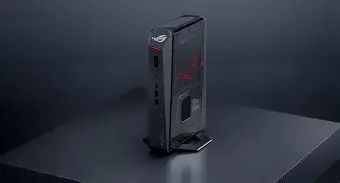
What I noticed immediately is that the ROG NUC 2025 feels dense and intentional, not like a flimsy box built to hit a price point. The chassis has that “serious hardware” vibe—more like a compact workstation than a bargain mini PC.
That said, I did run into a small annoyance: the “gamer” styling is toned down compared to some ROG products, but it’s still present. If you want something that completely disappears into a minimalist office aesthetic, this might not be your perfect match. It doesn’t scream for attention, but it definitely isn’t pretending to be a plain corporate box either.
Desk Space and Cable Reality
People buy a mini PC thinking it will eliminate cable clutter. What I found was: it changes the clutter more than it eliminates it. You still have display cables, peripherals, and power. The upside is that the machine itself can be tucked behind a monitor, placed vertically, or kept off the floor. The cable mess becomes easier to manage because the PC doesn’t demand a big footprint.
Performance: Why It Feels Faster Than My Old “Big” Desktop
Let’s talk about the reason anyone cares: performance.
I’m not going to pretend I benchmarked it like a lab, but I did test it the way real owners do—by living with it. What stood out most wasn’t just raw speed; it was the consistency. With past compact systems I’ve owned, performance would feel great for 10 minutes and then quietly degrade once heat soaked the chassis. The ROG NUC 2025, in my experience, holds up much better during longer sessions.
Everyday Work: Snappy in the Ways That Matter
For productivity, it feels instant. Apps open quickly, switching between tasks is smooth, and multi-monitor use is stable. I was surprised by how “unremarkable” it felt—in the best way. No weird stutters. No mysterious pauses. It just behaved like a serious PC.
One small disappointment: some of the included software utilities (common on gaming-oriented machines) felt more like clutter than value. I ended up trimming background apps because I prefer a clean Windows experience. Once I did that, the system felt even more responsive.
Gaming: The Real Reason Everyone Talks About It
Gaming is where the ROG NUC 2025 earns its hype. The reason people are buying it, from what I’ve seen, is that it hits a sweet spot: strong performance without requiring a full-size tower, and without forcing you into an oversized gaming laptop.
Find top-rated Laptops & Computers products at great prices.
Shop Amazon →My experience was that it delivered high, stable frame rates at the settings I actually want to use (not just low/medium “competitive” modes). What I appreciated most was how it handled longer sessions: less performance wobble than I expected from a compact box.
Thermals and Fan Noise: Better Than I Feared, Still Not Silent
I’m sensitive to noise. I work near my PC, and a high-pitched fan can ruin my day. I was prepared to be annoyed.
Here’s the honest reality: under light use, it’s easy to live with. Under gaming load, it becomes clearly audible. It’s not a “jet engine” in my setup, but it’s also not whisper-quiet. The good news is the character of the noise matters: what I noticed was more airflow “whoosh” than a piercing whine, which is much easier to tolerate.
One thing that bothered me early on was fan behavior that felt a little too eager—ramping up quickly during certain spikes. After some tweaking (power profiles and letting the system settle with updates), it improved. Still, if you’re expecting Mac-mini silence while gaming, that’s not realistic.
Ports, Connectivity, and Practical Use
The most underrated reason to choose something like the ROG NUC 2025 is connectivity. Laptops often make you live the dongle life. A tower is great but huge. This gives you a compact footprint while still being “desktop-like” for ports.
I regularly connect:
- Multiple USB devices (keyboard, mouse, headset receiver, external drive)
- A monitor (sometimes two)
- Occasional controllers
- Ethernet when I want rock-solid online play
In day-to-day use, I never felt like I was constantly juggling adapters. That’s a bigger quality-of-life win than I expected.
Wi-Fi and Ethernet: Stability Matters
Over Wi‑Fi, it’s been stable for me for work calls and downloads. When I switch to Ethernet, online play feels a touch more consistent (as expected). I know that sounds obvious, but what I’m really saying is: I didn’t fight mysterious dropouts or “why is my ping weird today” problems that I’ve had on a few compact PCs in the past.
Upgradability and Maintenance: Easier Than a Laptop, Not as Free as a Tower
This is where mini PCs either delight you or disappoint you. With laptops, upgrades can be limited. With towers, upgrades are a playground. With the ROG NUC 2025, I’d describe it as practical upgradability.
I like that I can access internal components more easily than with most laptops. That mattered to me because I wanted to feel confident I could extend the life of the system—storage upgrades, memory adjustments, and general maintenance without feeling like I’m defusing a bomb.
What I found was that it’s very doable for an average enthusiast, but it still requires more care than a full-size desktop where everything is spaced out. Compact builds demand patience.
Software Experience: Great Hardware, Some “Gaming PC” Baggage
Hardware is only half the ownership experience. The other half is how the system behaves in the real world: updates, utilities, and general reliability.
Overall, mine has been stable. No recurring crashes, no persistent driver nightmares, and no weird sleep/wake issues that sometimes plague niche compact systems.
The downside is the usual “gaming ecosystem” stuff. In my experience, you may end up with extra utilities that try to manage performance modes, lighting, updates, or telemetry-like features. I’m not accusing anything nefarious—I just prefer a lean setup. I spent an evening uninstalling what I didn’t want and turning off unnecessary startup items. After that, it felt like my PC rather than a showroom demo.
Pros & Cons (From an Actual Owner)
Pros
- Excellent performance-per-size that feels consistent during long sessions
- Desk-friendly footprint that makes a clean setup easier
- Great “laptop alternative” if you mostly use an external monitor anyway
- Strong connectivity for peripherals and multi-display setups
- More serviceable than most laptops for storage/memory changes
- Stable day-to-day behavior once I trimmed unnecessary background utilities
Cons
- Not silent under load; gaming brings noticeable fan noise
- Still requires a full setup (monitor/keyboard/mouse), which some people underestimate
- Compact maintenance requires patience; less “spacious” than a tower
- Bundled utilities can feel like clutter if you prefer a clean Windows install
- Value depends heavily on configuration; some builds make more sense than others
Comparison: ROG NUC 2025 vs Gaming Laptop vs Small Desktop Tower
When friends ask me whether they should buy the ROG NUC 2025, I usually respond with questions, not a yes/no. It depends on how you live with your computer. Here’s the simplest way I can compare it after months of ownership.
| Category | Asus ROG NUC 2025 | Gaming Laptop | Small Desktop Tower |
|---|---|---|---|
| Portability | Easy to move, but needs external display/peripherals | True grab-and-go with built-in screen/keyboard | Usually stationary; moving it is annoying |
| Desk footprint | Minimal; can tuck behind monitor | Medium; laptop takes surface space | Larger; often ends up on or under desk |
| Performance consistency | Strong and steady for its size (in my use) | Can be great, but often more thermal-limited | Typically best due to airflow and component headroom |
| Noise under load | Audible; manageable but not quiet | Often louder and higher-pitched | Can be quiet with good cooling, but varies |
| Upgrade flexibility | Some upgrades; better than most laptops | Usually limited (often storage/RAM only) | Best-in-class; easiest to swap parts |
| Total setup cost | PC + monitor + peripherals (if you don’t already own them) | All-in-one purchase, fewer extras | PC + monitor + peripherals (similar to NUC) |
| Best for | People who want power without a tower and don’t need built-in screen | People who truly travel or need one device for everything | People who want maximum upgrade freedom and airflow |
Why Everyone Is Buying It (My Take After Living With It)
I think the ROG NUC 2025 is selling so well for a few very practical reasons, not just hype:
Discover deals on Laptops & Computers — updated daily.
See Deals →1) It Solves the “I Don’t Want a Tower” Problem Without Forcing Laptop Compromises
I know a lot of people who don’t want a big case on the floor, don’t want a glass side panel, and don’t want their room to look like a gaming expo booth. They still want real performance. This fits that lifestyle.
2) It Makes Sense for People Who Already Own a Good Monitor
If you already have a monitor you love, a keyboard you’re used to, and a mouse that fits your hand, a gaming laptop can feel wasteful. You pay for a screen you might not use much at home. With the NUC, you put the budget toward the actual computing experience.
3) It’s Flexible in a “Modern Living Space” Way
I’ve moved mine between rooms more than I expected. Not every day, but often enough that it feels like a feature I actually use. I was surprised by how much I valued that flexibility when I wanted to change my environment without losing my setup entirely.
Buying Guide: How I’d Choose a ROG NUC 2025 Configuration Today
If you’re considering buying one, here’s what I’d pay attention to based on what mattered most in my ownership experience.
Decide What You’re Replacing
Before you pick specs, be honest about what this replaces:
- Replacing a laptop? Budget for a monitor (or a portable monitor), a keyboard, and a mouse. Also think about speakers or a headset.
- Replacing a desktop tower? You may already own everything else, so the NUC is mostly about space and convenience.
Prioritize the GPU Tier for Gaming (and Cooling Comfort)
If gaming is your main reason, the GPU choice matters more than almost anything else. What I noticed is that better-performing configurations don’t just increase frame rates—they can also make the experience feel smoother because you aren’t constantly pushing the system to its limits.
In other words: buying “just enough” performance can sometimes create more fan noise and more thermal pressure because you’re running near the ceiling all the time. I generally prefer a bit of headroom.
RAM: Don’t Undershoot If You Multitask
If you’re like me and you keep a ridiculous number of browser tabs open while running other apps, RAM matters. I noticed the system felt best when I wasn’t hovering near memory limits. If you do creative work or heavy multitasking, prioritize a comfortable amount of memory from the start.
Storage: Plan for Real Game Sizes (and Scratch Space)
Modern games are huge. Add a couple of large titles, a few creative apps, and some project files, and you’ll fill a drive faster than you think. My recommendation is to plan storage with breathing room. It’s not just about capacity; it’s about keeping enough free space for updates and smooth performance over time.
Ports and Monitor Choice: Don’t Accidentally Bottleneck Your Experience
One thing I appreciated is how “desktop-like” this feels with the right monitor. But you can also accidentally cheap out on the display and then wonder why your new system doesn’t feel as impressive. If you game, choose a monitor that matches your performance goals (refresh rate, resolution, and a panel you actually like living with every day).
Consider Your Noise Tolerance
This is a personal one. If you’re extremely noise-sensitive, think about where the unit will sit. In my experience, placing it a little farther from ear level helped. Also, if your desk setup forces it into a tight corner with poor airflow, you’ll hear it more.
Who I Think Should Buy the ROG NUC 2025 (and Who Shouldn’t)
You should consider it if:
- You want a powerful gaming/productivity PC but don’t want a tower
- You already own a monitor and peripherals you like
- You want something you can move easily without committing to a gaming laptop
- You value a clean desk setup and hate bulky hardware
You should probably skip it if:
- You truly need all-in-one portability with a built-in screen and battery
- You want the quietest possible machine under gaming load
- You love frequent major upgrades and want the freedom of a full tower build
- You’re starting from scratch and don’t want to buy monitor/peripherals separately
Conclusion: It Earned Its Place on My Desk
After using the Asus ROG NUC 2025 for several months, I understand why it’s become such a popular buy. It delivers that rare combination of real performance and real livability in a form factor that doesn’t dominate your space. It isn’t perfect—fan noise under load is still a thing, and I could do without some of the extra software—but the overall experience has been consistently better than I expected for something this compact.
What I found most convincing is how it fit into my daily routine. I stopped thinking about the PC and just used it. Work felt smooth. Gaming felt strong. And when I wanted to change my environment, I could move the whole system without making a production out of it.
If you’re the kind of person who wants a clean setup, already likes external monitors, and wants power without a full-size desktop, the ROG NUC 2025 makes a lot of sense—and in my case, it genuinely lived up to the hype.